
After over 35 years, a progressive rock song suite called The Dream of Kings, created in 1988 under the moniker Dark’s Ensemble with my old friends Kevin Brown and Paul Lesinski, is finally being released to the world remastered and remixed. The work explores post-apocalyptic themes from the front seat the cold war in the late 1980s; unfortunately, it still feels surprisingly relevant today. We commissioned real human artists, including my daughter to contribute to the visuals as well. Visit the Dark’s Ensemble website to learn more. Listen to the piece on Spotify, Apple Music, or wherever you stream music.
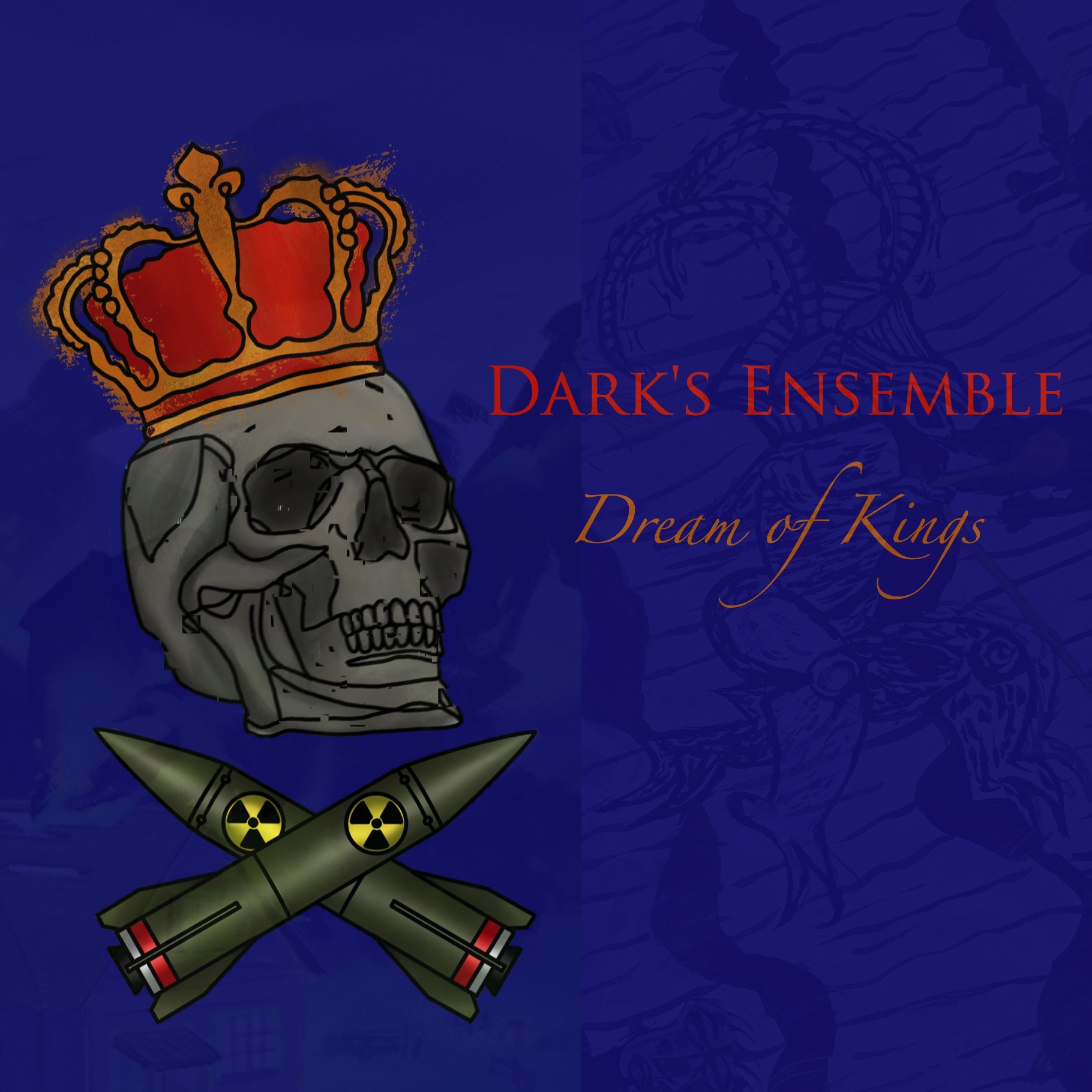
Below is a repost of a blog I made on the Dark’s Ensemble website that describes the history of Dream of Kings and creative context from my perspective:
The year 1988 was an incredibly creative time in life for all three of us. Paul, Kevin, and I had played in high school bands together circa 1984-1986 and had done various projects in the South Bay of the San Francisco Bay Area since that time, at least when studies and other commitments allowed. Paul and I collaborated regularly on free-form creative projects fueled by all night binging on gummy bears, pop tarts, 9012-live, and Song Remains the Same. There were many fun projects Paul and I did with various friends after high school including Fred [the band], RDVK [sic] (pronounced “Aardvark”), and Golden Dawn. Paul was also doing his amazing work in The Strangers. I had the honor of briefly playing bass in the Strangers for a few months while they were based in Santa Clara.
Also at that time, the three of us were in a loosely formed group called Dark’s Ensemble and had already created a few decent songs. We were all influenced in part by the progressive rock of the 1960s, 70s, and 80s including bands like ELP, Rush, Yes, Genesis, and others. I think there was a sense that the time had come for us to have our own epic concept album masterpiece. We felt that, at the ripe age of 20, we were in danger of ageing-out given that some of those bands produced their best work in their 20s.
Than band name? The novel Something Wicked This Way Comes by Ray Bradbury is a haunting dark fantasy masterpiece set in a mid-20thcentury autumnal, so-orindary-its-creepy, small-town America. It is really a narrative on the challenges of growing up, largely focused on the trials and tribulations of a nuanced father-son relationship. In the book, a mysterious being, Mr. Dark, brings his carnival to the outskirts of this tiny place. The name Dark’s Ensemble is a nod to that character and is meant to evoke the image of being the house band for the carnival with a twisted steampunk skew.
I have fond memories brainstorming on Dream of Kings in Paul’s suburban home in Cupertino, California. I remember that we quickly cranked out the full composition, which became a six-cycle song suite (depending on how you counted the tunes). Most of the writing took place in Paul’s bedroom and garage over a couple weekends through a few all-nighters. There is a longer tale of refinement, but there was a lot of work at Paul’s house putting it to a 4-track demo that included all six songs.
This was the late 80s. Post-apocalyptic themes were less science fiction horror and bordered more on “this could literally be next Tuesday.” I was very oddly fixated on that nuclear war genre as a teen. Growing up, I was into this post-apocalyptic role-playing game from 1978 called Gamma World, which was a close cousin to Dungeons & Dragons, as well as Car Wars. Indeed, while the reality of those worlds are pure awfulness, I still love that genre. There is something oddly liminal, romantic, and mysterious about imaging an empty world and what living in that desolation might feel like. It is that dry, disquieting loneliness, captured in the book Earth Abides or the game Myst. This abstract feeling tracks a lot of the liminal spaces, “backrooms,” and stark modern loneliness captured in many recent video and creative trends.
As children of the 70s and 80s, all of us had a steady diet of cold war science fact and fiction. Ronald Reagan was president, tensions were high in the Middle East, and the cold war was still grinding with The Soviet Union. The first Terminator movie had come out in 1984. War Games and The Day After in 1983. There were dozens of these kinds of dystopian creative pieces to digest through the 70s and 80s like Mad Max, Logan’s Run, THX 1138, and so on and so on. This theme of machine- or computer-driven nuclear war, and what that aftermath might look like, was very much on everyone’s mind. These fixations continue in modern culture with shows and games like Fallout and House of Dynamite.
The unique twist I love about Dream of Kings in this landscape is that it imagined a technology-driven forever war. World War III? Yes, that is horrible. But what about Four? Five? N? Can the cycle even stop once that unholy engine is started? Seemed like a timely and creative theme to explore. Unfortunately, this isn’t as irrelevant in 2026 as we hoped it might be. Most of the nukes are still around and there are more nuclear weapons states now than in the 1980s. Extreme advances in drone technology as deployed in Ukraine and Iran, for example, and advances in bio-inspired robotics from companies like Boston Dynamics, ensure the major role of automated systems in modern warfare. And, of course, there is the alarming rapid expansion of unregulated AI, LLMs, etc. into the wild we are seeing in the 2020s. AI is a beautiful, transformational technology but has many perilous failure modes we ignore at our own existential risk. This tech is wadded up in unexpected ethical moral knots we must untangle if we are going to survive with our humanity intact.
We continued to have to confront these ideas during this production. What if the horrific imagery was just a dream and leaders could learn? Like A Christmas Carol or It’s a Wonderful Life. Perhaps too naively optimistic? Or, what if we were just dreaming that we were dreaming and the nightmare is doomed to involuntarily cycle forever? And who was dreaming exactly? The three of us riffed on these ideas when composing the piece and the narrative you hear in the song emerged from the lyrics (mostly Paul’s) as it zoomed into various individual experiences in this world. For me, the entire piece from All That I Know to The Dream of Kings is very geographic and starts in the southwest and pans its way to the Rockies and then across to the East Coast, expanding from there to the whole world and into infinite recursion.
In 1988 Paul and I had a pileup of musical ideas we introduced during these sessions, which came in the form of everything from nearly completed songs to quirky interludes to catchy riffs. As I recall, the musical ideas were split evenly between Paul and me, but we all built on those ideas democratically. We all worked together with lots of back and forth to pull together the arrangements. Kevin brought focused feedback and crafted his drum parts that weaved the songs into a collaborative whole. Paul wrote some very strong lyrics right away. Kevin and I contributed some occasional lyrical lines, stanzas, and contributed ideas and images. Paul always has had strong visuals and symbolism in his songwriting, and it was amazing to watch him work so quickly.
As Paul has described elsewhere, I knew a fellow student at San José State University named Brett (sorry, man, I can’t remember your last name!!). He and I played in an improv ensemble together and he was taking a sound engineering class as part of the music major. He had to do a final project, and I suggested he record Dream of Kings. Perhaps there are fewer things crueler than the polite acceptance of a casual invitation. He was game but had a short runway and wanted to graduate. I explained the music to him, but I got the feeling most of his classmates were doing two-minute songs for their projects; here poor Brett gets tangled up in a complex six-song 25-minute prog rock science fiction piece. Brett brought studio experience from an 80s heavy metal background, and we did a quick setup in one afternoon in this small 16-track analog studio in the SJSU music building. Much time was rightly spent mic’ing the drums. We had only reserved the studio for a half-day and had to move fast. However, it was wonderful! The no-nonsense pace kept us focused and energetic. We were twenty years old and our whole lives were ahead of us. Great memories.
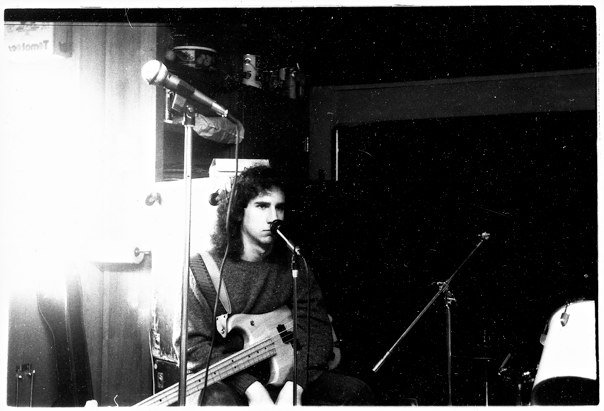
After doing some basic mixes and mastering over the next few weeks offline (so Brett could graduate!), we moved on. I arranged to get the tape from him, and I regretfully lost touch. The recording, performances, and mixes weren’t perfect. There were saturated drums on some parts, lots of little timing errors, off-key singing (mostly on my part), and an out of tune keyboard. Too much return from the echo bus on some tracks lead to an unintentionally comical rambling delay on some vocals.
Being an archival genius, I then stored the original reel-to-reel Ampex 456 tape in my mom’s garage at the bottom of a plastic tub, which naturally “aged like a fine wine” – not! More than ten years later Paul reached out and wondered what had happened to the master tape. Yes, I’m an archivist, but with very high entropy. That is, I have all the stuff around (like a hoarder) but am not very careful with the precious items I steward. However, Paul is our true archivist, and it really did belong with him in his hermetically sealed vault. Bless him.
Paul spent many years on and off noodling with the tracks, getting the Ampex tape professionally repaired and re-baked, stripping the stems off digitally, and so on. We knew we had some fantastic music material there, and the drum recording in particular was so well done thanks to Brett’s skills and Kevin’s performance — but it just wasn’t quite ready to deploy out of the box. For example, some of the instrumentation was detuned and out of phase.
In late 2024 Paul ran the idea past Kevin and me wondering if we wanted to try and get Dream of Kings ready for a public launch by early 2026 (I think we originally targeted mid-2025, but that proved too ambitious). It dawned on me that this music, which I had listened to quite a bit for fun for years from our 1988 4-track recording, had never been shared with the world. Yes, it needed TLC for public consumption, but the core musical material just felt so strong from our 1989 session. We are all spread along the West Coast with busy family lives and careers, but modern technology smoothed the collaboration. Paul did the massive lift on the music mixing and studio production work. Kevin’s drums were already fantastic, but we all wanted to adjust some details: redo some solos, synchronize some loose bits, tighten the vocals, tweak the mix, improve the voice overs, and fix the intonation on some parts. It was a healthy collaboration and there was lots of honest feedback and transparency back and forth.
That said, we agreed we didn’t want to “George Lucas” this thing, monkeying with our creation so much it lost connection with the original youthful raw spirit that made it special to us in the first place. To perfect it in the eyes of an addled, middle-aged self, one can end up diluting the imperfect, authentic creative passion; creations of this kind are fragile and in danger of spiraling into absolutely perfect mediocrity. But we also didn’t want to forever cringe at permanent errors made public we could have fixed. I’m being a bit hard on Old George but, let’s be honest, he’s a cautionary tale. One advantage we had over George (and there aren’t many) was that there were no external expectations. Most people didn’t know Dark’s Ensemble or Dream of Kings existed. The only people we had to please were ourselves. The experience was less “fixing something” and more like being a time traveler, collaborating with both the past and present to simply make the best song possible with the resources we had.
As a stand-alone tune, my personal favorite is All That I Know. I just dig that opening siren and jazz-rock feel, placed oddly in tension with those apocalyptic vibes. This is the gnawing ear worm for me. A close second is Capitol Hill, which is such a funky tune, but has this dark, cynical message that feels like a documentary circa 2026 than a phantom under the bed. However, World War IV has the strongest overall musical themes and performance in my view. Paul’s lyrics are powerful and vivid here. I get lost in the music as it switches into different themes, painting this grim image transitioning from a lucid dream state into something murkier as it segues into The Dream of Kings. The groove at the end of Caverns Part 2 brings me such pleasant nostalgia jamming in Paul’s garage as teenagers channeling early Rush. Such good feelings for me there!
Kevin’s drum performance is so absurdly brilliant through whole the piece I basically find myself listening agape if I focus on the drums alone. Paul’s guitar work and solos are subtle, amazing, and unique, carrying his signature voicings. Paul’s vocals were always solid growing up, but he has improved with his extensive musical performance experience over the years. His delivery is epic and passionate on this mix.
Zooming in more, I have to say I just love the opening wah-wah on Capitol Hill. I also love the ethereal strumming guitar and drum fills during the “wake me up” sequences in World War IV. That gave me a lot of room to riff with the bass trying to channel Chris Squire and I just swoon over those combinations of sounds. Kevin’s biting lyric about “I saw the spot where the last flower grew…” in Capitol Hill is just chilling. Cavern’s Part 1 is a driving prog rock piece I wrote that I’m extremely proud of as an arrangement. It hops time signatures like crazy, and it has some prog synthy goodness going on. Thematically, that piece signals the macabre procession of the machine warlords driving the survivors underground.
I want to thank my lifelong brothers in musical collaboration, Paul Lesinski and Kevin Brown. I love you guys and let’s always try to find time to create and grow together even if we can’t always be near each other geographically.
Thanks to anyone reading this far and I hope you enjoy Dream of Kings as much as we loved creating and refining it.
–TDG, San Luis Obispo, 2026